


In a nutshell
HR technology and AI are changing how companies manage their talent. These tools simplify tasks like hiring, onboarding, and performance reviews, making them faster and more accurate. They also help in identifying future leaders, offering personalised development plans, and ensuring a diverse and inclusive workplace.
By using these technologies, companies can keep their employees happy, motivated, and less likely to leave. This blog explains how HR tech can make talent management more efficient and effective, with real-life examples and tips for organisations looking to improve their processes.
HR Technology in Talent Management
HR Technology has become mainstream.
Whether you’re catching up on social media or watching TV, you’ve probably noticed ads for HR platforms popping up. These tools promise to make managing people easier, and it seems like everyone’s jumping on board. According to Deloitte’s 2023 Global Human Capital Trends, 74% of executives are ramping up their investments in HR tech to boost performance.
Another report by Grand View Research estimated the HR tech market at USD 24.04 billion in 2023, and it’s expected to grow by at least 10% p.a. in the coming years.
Artificial Intelligence (AI) adds another layer to this HR tech arms race. While some HR professionals have reservations, many companies are learning to embrace these new tools and wondering how they got by without them.
However, even as these tools become more popular, some areas seem stuck in the past.
At Change Associates, we’ve worked with many organisations on talent management projects and are surprised to see how some clients still rely on spreadsheets.
In this post, I’ll explore the elements of talent management and discuss how HR tech can make these processes more efficient and effective. I’ll also share a case study where we helped a global mining firm with its talent management programme and consider how we might approach it differently with the right HR technology.
What is Talent Management?
Talent management is about getting the right people on your team, helping them grow, and keeping them happy and productive. Think of it like being a coach for your company, ensuring everyone is playing at their best.
Key components include
Finding and attracting people who have the skills and qualities your company needs.
eg: A tech startup uses targeted social media and job boards to attract talented software developers.
Helping new employees settle in and understand how things work.
eg: A new marketing hire goes through a fun and informative onboarding programme, learning about the business, meeting key stakeholders, and receiving training on company tools.
Regularly checking in on how employees are doing, giving feedback, and setting goals.
eg: A retailer holds quarterly reviews, during which managers and employees discuss progress, set new goals, and talk about career growth.
Offering opportunities for employees to learn new skills and advance their careers.
eg: A company offers workshops and online courses to help high-potential employees develop leadership skills.
Identifying successors and preparing them to step into key roles as the company grows or leaders retire.
eg: A pharmaceutical organisation trains a group of researchers for future leadership positions through specialised programmes.
Strategies and tactics to keep top performers engaged and loyal.
eg: A financial services firm conducts employee surveys to gather feedback, offers great pay and benefits, and shows clear paths for career advancement.
Using data to make smart decisions about talent management.
eg: A FinTech organisation uses HR analytics to track employee turnover, identify skill gaps, and measure the success of training programs.
These elements are key to staying competitive and ensuring your team is happy, skilled, and motivated.
Case Study
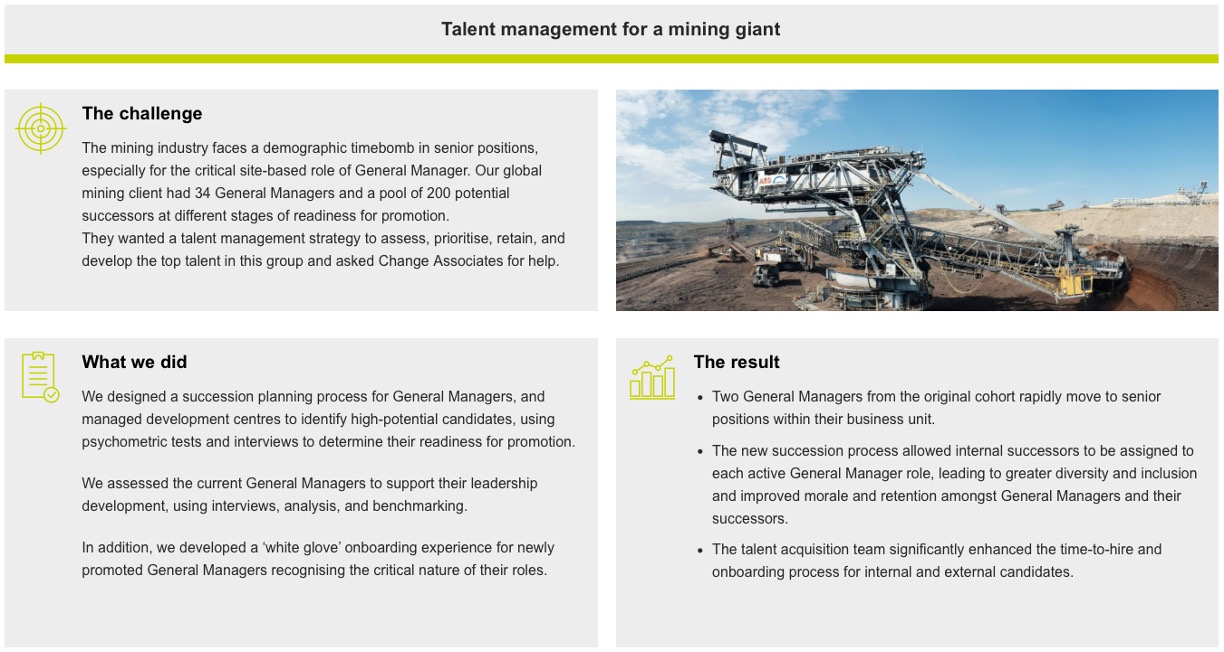
Last year we completed a talent management project with a large mining firm, which you can read about here: Talent Management Case Study.
Challenges – and what we’d do differently
Although our client was happy with what was achieved, we could see how leveraging technology could have given them an even better result in overcoming a number of challenges they experienced.
The geographic spread and variety of mining assets added complexity to the programme. Different sites operated as separate businesses, which meant varying approaches to talent management. Some mines wanted to push their leaders forward, while others hesitated for fear of losing key talent.
The biggest challenge, however, was the lack of investment in HR Technology. The entire succession process relied on spreadsheets and PowerPoint presentations.
We did well with what we had, but this manual process had several drawbacks:
- Time: Maintaining and updating data was slow and manual.
- Accuracy: Manually making small changes increased the risk of errors in reports.
- Limitations: Adding external candidates to data sets and presentations was challenging, particularly trying to define and capture their match to the skills and competencies we were using in the process.
- Data Governance: Handling sensitive information raised security and governance concerns.
- Candidate Experience: The slow process negatively affected candidates, causing some to leave before the succession process was completed.
- Inflexibility: Real-time data couldn’t be used to dynamically assign individuals to succession plans.
- Data Errors: Inconsistencies eroded stakeholder confidence.
In short, the cumbersome talent management process led to the loss of high-potential future leaders. The slow-moving and discouraging process left candidates feeling undervalued, and some decided to explore opportunities elsewhere.
How HR Technology could have helped
While HR Tech isn’t a magic solution, it can greatly improve processes when paired with a thoughtful HR transformation programme that redesigns processes and engages the workforce.
For organisations ready to embrace this journey, HR technology platforms and AI can optimise the entire process. Here’s how:
1. Improved Data Management and Analytics
- Automation and Real-Time Updates: HR technology platforms automate data collection, reducing reliance on spreadsheets and presentations. This allows for real-time updates and integration across various sites, giving everyone access to current information.
- Accurate Reporting: Automating data entry and analysis significantly reduces the risk of errors. AI can quickly process and analyse large amounts of data, providing accurate and reliable insights into candidate readiness and potential.
- Unified Data View: The platform provides a centralised view of all talent-related data, making it easy to access comprehensive information about each candidate. This supports better decision-making and more effective succession planning.
Example: Instead of manually compiling reports, HR teams can access a dashboard displaying real-time updates on each candidate’s progress, readiness for promotion, and performance metrics, enabling them to make data-driven decisions quickly and efficiently.
2. Enhanced Succession Planning
- AI-Driven Insights: AI analyses historical data and current performance metrics to provide insights into each candidate’s potential for leadership roles. This predictive analysis helps identify high-potential candidates who might otherwise be overlooked. AI solutions are particularly strong at matching skills against roles and candidates which substantially speeds up analysis.
- Scenario Planning: AI tools can simulate various scenarios, allowing HR teams to explore different succession plans and identify potential challenges and opportunities. This enables more proactive and strategic succession planning.
- Real-Time Adjustments: With real-time data updates, succession plans can be dynamically adjusted to reflect changing organisational needs and candidate progress, ensuring the right talent is always in place for key roles.
Example: The mining firm could use AI-driven insights to identify potential successors for General Manager roles who align with the company’s strategic goals and values.
For more on AI-enabled succession planning please read our white paper.
3. Learning and Development
- Personalised Career Paths: An HR tech platform can offer personalised career paths based on each candidate’s skills, aspirations, and potential. This ensures that employees understand their career trajectory and feel motivated to grow within the organisation.
- Targeted Skill Development: AI tools can identify skill gaps and recommend tailored upskilling and reskilling programmes. By focusing on continuous development, the organisation ensures its workforce remains competitive and adaptable to industry changes.
Example: Instead of a one-size-fits-all development programme, the platform could provide tailored learning opportunities for each General Manager candidate, focusing on specific skills needed for their unique career paths.
4. Skills and Capability Matching
- Skills-Based Assignments: AI can intelligently match employees to roles and projects based on their skills, availability, and potential for growth. This ensures the right people are assigned to the right tasks, enhancing productivity and efficiency.
- Real-Time Skill Tracking: The platform continuously updates and tracks employee skills, allowing the organisation to adapt to new project requirements and industry demands quickly.
Example: The mining firm could use AI to match candidates to specific General Manager roles based on their skills and cultural experience, ensuring the best fit for each site.
5. Diversity and Inclusion
- Inclusive Hiring Practices: AI-driven tools are becoming increasingly sophisticated at focusing on identifying candidates’ potential regardless of background, promoting diversity and inclusion. This approach ensures all candidates are evaluated fairly, and diverse talent pools are leveraged effectively.
- Connecting Diverse Talent: The platform enhances the ability to connect diverse talent with opportunities within the organisation, fostering a more inclusive work environment.
Example: The mining firm could use AI tools to ensure that hiring practices focus on potential and skills rather than traditional biases, allowing them to tap into a broader, more diverse talent pool.
6. Enhanced Insights and Analytics
- Data-Driven Decision-Making: AI provides deep insights into employee performance, skills, and potential, enabling HR teams to make informed decisions that align with strategic objectives.
- Unified Talent View: A centralised platform offers a holistic view of all talent within the organisation, supporting strategic workforce planning and management.
Example: Using HR technology, the mining firm could gain a comprehensive understanding of its talent landscape, allowing for more strategic and effective leadership development initiatives.
7. Improved Employee Engagement and Retention
- Growth-Focused Experience: An HR platform can engage and retain top talent by offering clear career paths and development opportunities.
- Succession Planning and Retention: AI identifies and prepares employees for future leadership roles, ensuring a strong talent pipeline and reducing the risk of losing high-potential candidates to competitors.
Example: By providing a transparent and engaging talent management process, the mining firm could improve employee satisfaction and retention, reducing the likelihood of candidates leaving the organisation due to a lack of perceived growth opportunities.
There are some great solutions in the market which harness the power of AI in the Talent Management space. One of our favourites is Eightfold AI, a talent-centred AI-native intelligence platform which leverages over a million skills and a billion career trajectories to enhance companies’ approach to talent management.
TechWolf is another fast riser, using existing systems to derive data on the skills of your workforce to support talent and skills development.
Conclusion
By integrating an HR technology platform with AI capabilities, organisations can revolutionise their talent management processes. This integration not only streamlines operations but also enhances employee engagement, diversity, and retention. Through personalised career development paths, skills matching, inclusive hiring practices, and data-driven decision-making, organisations can create a dynamic, future-ready workforce poised for success.
Embracing HR technology and AI enables organisations to overcome current challenges and proactively adapt to future needs. This ensures that high-potential candidates feel valued and motivated, reducing the risk of losing future leaders to competitors.
If you want to improve any aspect of talent management, from shaping your strategy to implementing new HR technology, we’d love to help.
Images (c) Shutterstock | PhotonPhoto

- My first three months in Norway: What I’ve learned about work, culture, and opportunity in the Nordics - 12 December 2025
- HR Technology in Talent Management - 3 September 2024